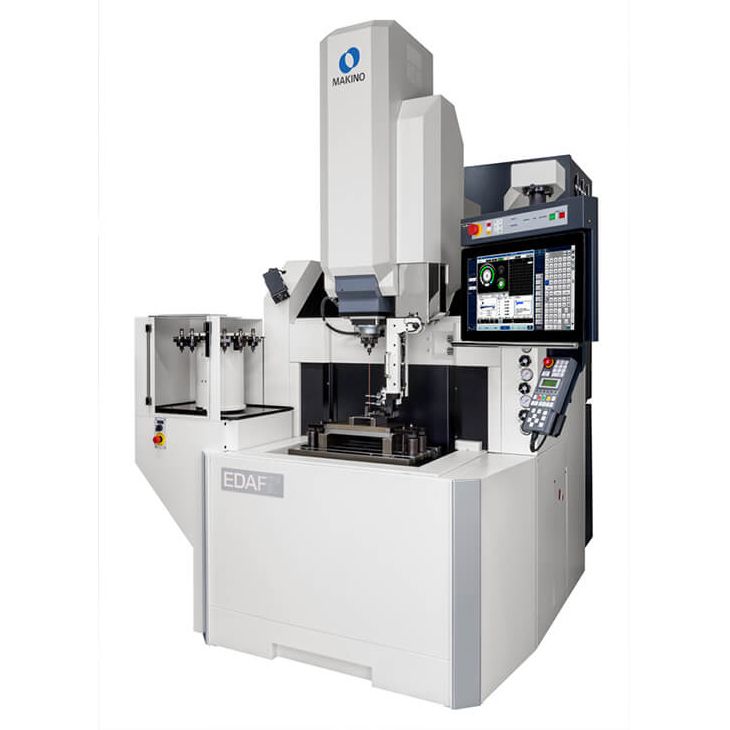
NCMT supplies Makino EDM drilling machines for producing accurate small-diameter , deep and complex holes in electrically conductive materials, particularly where conventional drilling methods are limited by material properties, feature geometry or tool access.
EDM hole drilling uses a rotating tubular electrode and controlled electrical discharges to remove material without conventional cutting forces. High-pressure dielectric flushing through the electrode removes debris from the machining zone, supporting the production of small, deep and angled holes with controlled accuracy and repeatability.
The Makino EDM drilling range supports applications from high-precision fine-hole machining to high-volume production of cooling holes and other critical features in turbine components.
Our applications engineers work with manufacturers across aerospace, energy, medical automotive and motorsport, subcontracting and mould & die to assess component geometry, material, hole characteristics, accuracy and production requirements and identify the most appropriate EDM drilling platform for the application.
Explore our range of CNC drilling machines and get in touch about selecting the right machine for your production requirements.
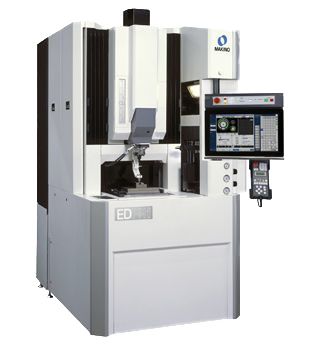
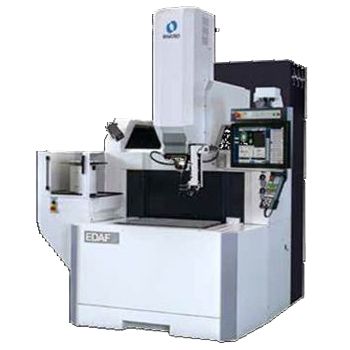
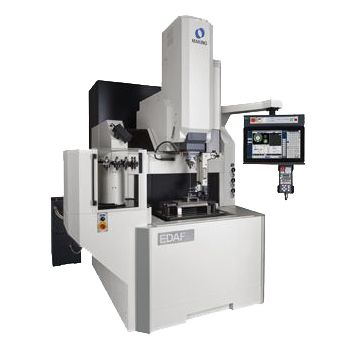
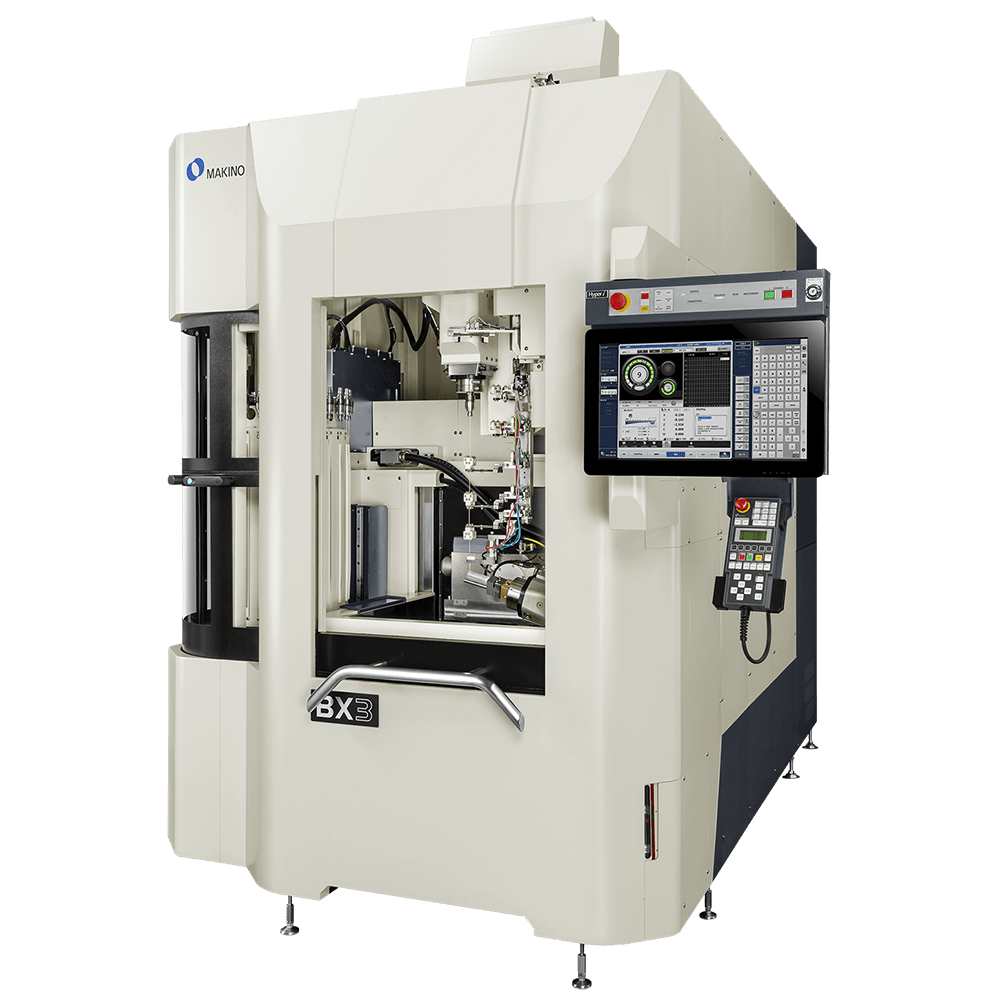
EDM hole drilling can provide an advantage where small-diameter, deep, angled or high-aspect-ratio holes are difficult to produce reliably using conventional cutting tools, particularly in hard or heat-resistant electrically conductive materials.
Because material is removed by electrical discharge rather than mechanical cutting, the process does not rely on conventional cutting forces. The decision should nevertheless consider hole geometry, required accuracy and surface integrity, cycle time and production volume to determine whether EDM provides the most appropriate process.
Electrode selection depends on the required hole diameter, depth, aspect ratio and accuracy rather than hole diameter alone.
Smaller and longer tubular electrodes become increasingly sensitive to vibration, bending and run-out, particularly when producing deep or high-aspect-ratio holes. Electrode guides and intermediate support can therefore be important for maintaining hole position, straightness and consistency. The machine should be evaluated against the complete electrode, guide and flushing arrangement required for the application.
The choice of dielectric depends primarily on the required balance between machining speed, accuracy, edge quality and metallurgical condition.
Oil dielectric is particularly suited to high-precision hole drilling where dimensional control, edge quality and surface integrity are critical. Deionised water is commonly used where higher drilling speeds and production throughput are priorities.
The appropriate process should therefore be selected around the finished-hole requirement rather than machining speed alone.
High-pressure dielectric flushing through the tubular electrode removes eroded material from the discharge gap and helps maintain stable machining conditions.
The required flushing performance depends on electrode diameter, hole depth, aspect ratio, material and discharge conditions. Insufficient debris removal can reduce machining stability and productivity, while the machine, electrode and guide system must also be capable of operating reliably at the required pressure.
Flushing capability should therefore be assessed as part of the complete drilling process rather than compared as a maximum pressure figure in isolation.
Breakthrough detection becomes particularly important when producing through-holes into internal cavities, where continued machining after breakthrough can increase cycle time or risk affecting an opposing internal surface.
The control system should detect breakthrough reliably and respond quickly enough to terminate or modify the machining cycle. For high-volume cooling-hole production, this capability can influence both component quality and total cycle time across large numbers of holes.
For critical components, hole quality should be evaluated beyond diameter and positional accuracy.
The EDM process creates a thermally affected surface, so applications such as aerospace cooling holes may require control of recast, heat-affected material and edge condition. Dielectric type, discharge energy, flushing and machining strategy can all influence the metallurgical condition of the finished hole.
Where surface integrity is critical, these requirements should form part of the process specification and machining trials rather than being assessed after the machine has been selected.
Cycle time should be assessed across the complete drilling process rather than machining speed alone.
The evaluation should include electrode positioning, drilling time, breakthrough detection, flushing, electrode and guide changes, movement between holes and any component indexing required. For components containing large numbers of holes, small reductions in positioning, tool-changing or breakthrough time can have a significant effect on total component cycle time.
A representative process study using the actual component geometry, electrode strategy and hole pattern can therefore provide a more meaningful comparison than individual machine specifications.